The Challenge of Scaling Ground Operations
How increasing flight volumes, multi-station complexity, and workforce scale create coordination demands that static planning tools weren't designed to handle.



As Air Astana enters its next phase of growth, its COO and operations leadership team share how the airline is preparing ground operations for greater scale and complexity, moving beyond static planning, and building the foundations needed to grow with confidence.

"As we prepare for the next stage of our journey, it's essential that our operational foundations evolve at the same pace."

How increasing flight volumes, multi-station complexity, and workforce scale create coordination demands that static planning tools weren't designed to handle.
Why predefined plans lose value quickly in dynamic operating environments and what the cost of reactive coordination actually looks like across a network.
How connected visibility, predictive planning, and continuous coordination allow teams to respond faster and operate with more consistency throughout the full operating day.
Why easie's unified planning-and-execution approach stood out during Air Astana's evaluation process, and how it aligned with the airline's long-term operational strategy.

"What stood out was the ability to bring planning and real-time operational decision-making together within a unified decision intelligence platform, which is exactly what a growing network airline like Air Astana needs as we scale."
What easie Does Differently
Most resource management systems are built for the plan. They help operations teams prepare for the day ahead: optimized rosters, allocated equipment, coordinated shift timings. Then the day begins, reality diverges from the plan, and those systems become increasingly disconnected from what is happening on the ground.
easie is designed for the full operating day. The platform connects workforce planning, equipment allocation, live operational data, real-time operational coordination, and mobile task execution within a single environment that updates continuously as conditions change, supporting decisions at every stage of the operating cycle, not just before it starts.
For Air Astana, this meant moving from a model where planning and execution were separate workflows, bridged by manual coordination, to one where teams manage both within the same operational environment, from the first shift plan to the last pushback.
Delivered in under six months, the implementation brought easie’s Resource Management, Real-Time Management, and Mobile Application capabilities live at Almaty International Airport, establishing a connected environment for planning and day-of-operations execution while supporting Air Astana’s continued growth.
Workforce planning, equipment allocation, and day-of-operations coordination are managed within one connected environment, bringing planning and execution together rather than treating them as separate workflows.
Planners, coordinators, and operational leadership work from a common operational view as conditions change, enabling faster alignment without relying on chains of calls or manual updates.
Real-time operational visibility enables teams to identify changes sooner, reallocate resources faster, and respond before local disruptions affect turnaround performance and downstream operations.

"Our frontline teams operate in a fast-paced, time-critical environment. Clearer plans, better visibility, and tools that support coordination and communication help them focus on delivering a safe, reliable, and high-quality operation."
Operational Impact
A connected planning and execution environment enables operational teams to respond faster to changing conditions, strengthen coordination, and maintain operational control as complexity grows.
Optimized shift plans aligned with live operational data reduce manual planning effort, allowing planners to focus on managing operational priorities rather than continuously rebuilding schedules throughout the day.
Continuously updated workforce and equipment plans help ensure resources remain aligned with changing operational demand, improving utilization while reducing last-minute staffing gaps and manual adjustments.
Shared operational visibility enables planners and coordinators to identify changes earlier, reallocate resources more quickly, and respond before local disruptions affect turnaround performance and downstream operations.
Connected planning, mobile task execution, and shared operational visibility give frontline teams the information they need to accept work, update execution status, and respond confidently as operational conditions change.
Following the interview, Air Astana successfully went live with easie's Resource Management solution at Almaty International Airport. The capabilities discussed by the airline's leadership team are now delivering measurable improvements across planning, coordination, and day-of-operations execution.
These early results reflect the initial operational impact following go-live, with further benefits expected as adoption expands and the solution becomes more deeply embedded across daily operations.
7 working days → 3 working days
Roster preparation time has been reduced from seven working days to three, significantly reducing the manual effort required to prepare and publish workforce schedules. Planning teams now spend less time creating plans and more time managing operational priorities.
Planning Reliability
Monthly planning exceptions requiring manual intervention decreased from approximately 30 to 10, significantly reducing corrective work and providing teams with a more reliable operational plan.
20 minutes → 5 minutes
The time required to communicate operational changes, assign tasks, confirm acceptance, and update execution status has been reduced from 20 minutes to just five, enabling faster coordination between planners and frontline teams.
Daytime Support → 24/7 Coverage
Air Astana expanded from 5 planners providing daytime support to 8 planners delivering continuous 24/7 planning, strengthening operational responsiveness as network complexity continues to grow.
Today, approximately 500 employees use the platform across Air Astana's ground operations, with deployment expected to reach around 800 users by the end of 2026. As adoption expands, these early improvements demonstrate how the new operating model can support Air Astana's continued growth without compromising operational control.

"Ground operations are one of the most complex and time-critical parts of the airline ecosystem. By adopting an AI-driven resource management approach, Air Astana is unlocking a new level of operational clarity and control. We are proud to support the airline in building the agility and efficiency required for its next phase of growth."

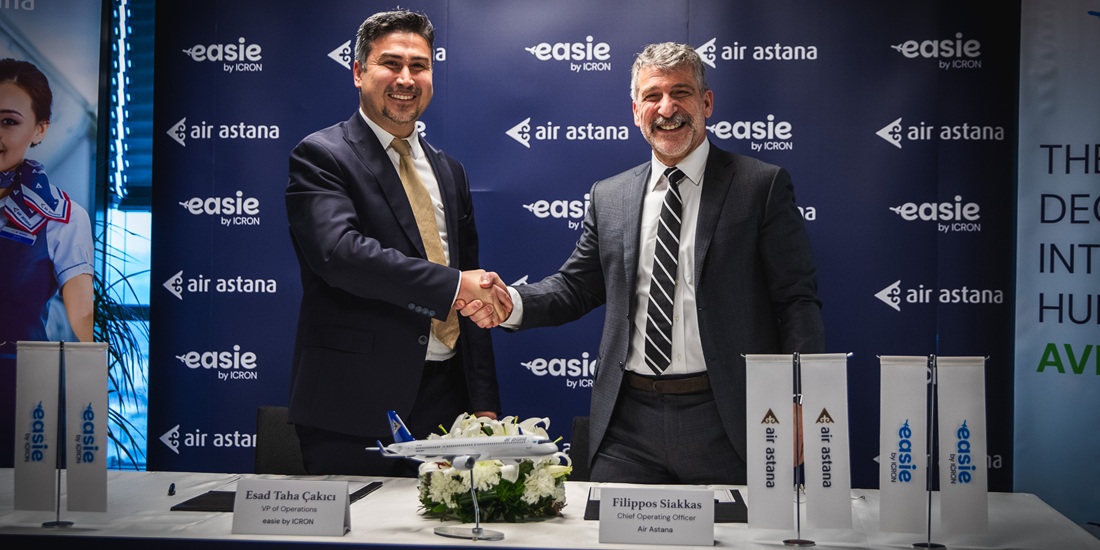
Press Release / 26.01.2026
Air Astana, Kazakhstan's leading carrier, has taken a major step forward in its digital transformation journey by selecting easie by ICRON, a global leader in AI-powered SaaS solutions for the aviation industry, to implement its Resource Management for Ground Operations solution.
Read More

Solution Overview
Expertly differentiated for mission critical functions.
Read More


 The Situation

 Operational Impact